Key Takeaways
- Baling machines compact waste materials, making storage and transportation more efficient for industrial operations in India.
- Shredding machines reduce bulky materials into smaller pieces, facilitating easier processing and recycling.
- Power Hydrotech offers a variety of baling machine and shredding machines in India, tailored for different waste types.
- Choosing the right machine involves analyzing material type, volume, and specific processing needs for effective waste management.
- Integrating both baling and shredding into one workflow optimizes industrial waste handling and recycling processes.
Power Hydrotech Private Limited is a leading manufacturer and exporter of baling and shredding machines for industrial waste management and recycling applications.
Industrial waste can quickly become difficult to store, handle, transport, and process when materials remain loose or oversized. In India, baling machines and shredding machines offer useful methods for reducing and compacting various waste types, assisting industry in managing materials more efficiently. From scrap metal and cardboard to plastic, rubber, and other recyclable materials, selecting the right machine can make daily waste handling more efficient.
What Are Baling and Shredding Machines?
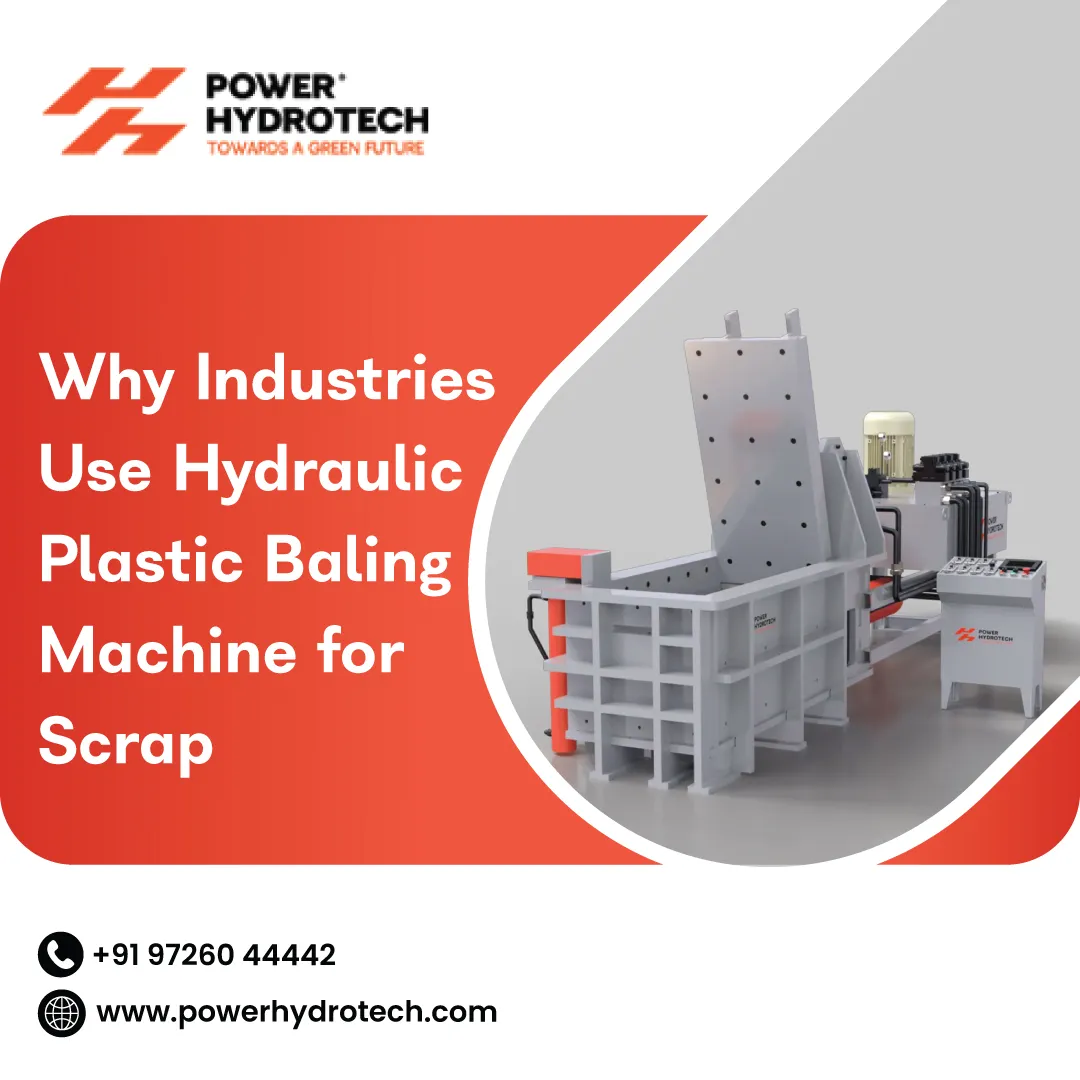
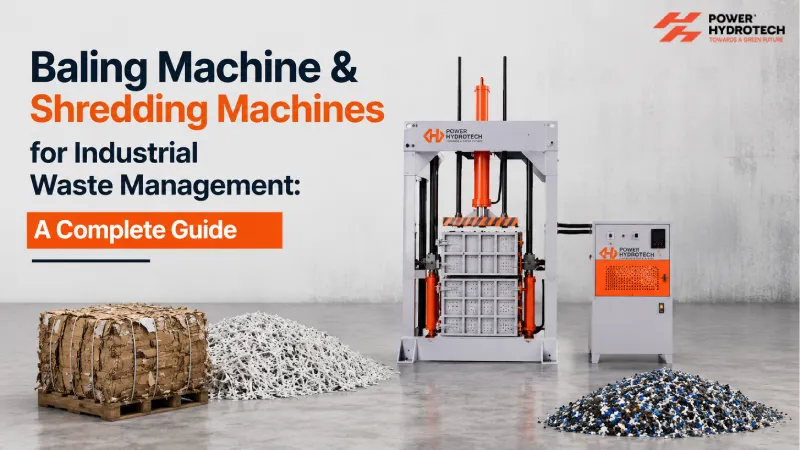
A baling machine compresses loose materials into compact bales. This makes the material easier to handle, store, move, and prepare for recycling or further processing. Power Hydrotech offers hydraulic balers designed for different materials and industrial requirements, including vertical, horizontal, and metal balers.
A shredding machine, on the other hand, reduces larger or difficult-to-handle materials into smaller pieces. Shredding is useful when waste needs size reduction before recycling, sorting, or subsequent processing.The two machine categories solve different waste-handling problems and can also work as complementary steps in an industrial recycling setup.
How a Baling Machine Supports Waste Management
Baling is mainly focused on compression and volume reduction. Loose materials take up more space and can be harder to move around a facility. A hydraulic baler compresses these materials into dense, manageable bales.
Depending on the machine and application, baling can be used for materials such as:
- Metal scrap
- Paper and cardboard
- Plastic and PET bottles
- Plastic film
- Textile waste
- Aluminium, copper, steel, and other metal scrap
The resulting bales can be easier to stack and transport, while compressed scrap can also be more convenient to handle during recycling and furnace charging operations.
How Shredding Machines Fit into Industrial Waste Processing
Shredding focuses on breaking down bulky or larger materials into smaller pieces. This can make downstream handling more practical, particularly where the incoming waste is irregular, oversized, or difficult to process in its original form.
For industrial users, shredders can be considered when the waste stream includes materials such as metal, rubber, plastic, or tyre waste. Power Hydrotech lists industrial shredders among its product offerings and provides waste-processing solutions for recycling applications.
The right shredding solution depends on the material being processed, the required size reduction, and the overall workflow of the facility.
Baler Machine vs Shredder Machine
The choice becomes easier when the purpose of each machine is clearly defined.
| Criteria | Baling Machine | Shredding Machine |
|---|---|---|
| Main function | Compresses waste | Reduces material size |
| Output | Dense bales | Smaller shredded pieces |
| Typical use | Storage, handling, transport, recycling | Size reduction and processing |
| Suitable materials | Paper, plastic, metal, textile, scrap | Bulky, tough, mixed, or recyclable materials |
| Main advantage | Better compaction and handling | Easier downstream material processing |
| Shaft configuration | Two parallel shafts | One main shaft |
| Material action | Cutting and tearing from two rotating shafts | Cutting against a fixed or counter surface |
| Torque requirement | High-torque operation | Application-dependent |
| Material handling | Suitable for bulky and mixed waste | Often selected for controlled shredding applications |
| Typical focus | Tough, bulky and varied materials | Size-controlled material reduction |
Both systems can have an important role in organised waste-processing operations, but they should be selected according to the actual material flow rather than used interchangeably.
Types of Baler Machines for Industrial Applications
In India, baling machines and shredding machines come in a variety of configurations. The type of baler should be chosen based on the material’s properties, the amount of space available, and the anticipated workload.
Power Hydrotech manufactures several baler categories:
- Vertical Baler: Often suitable where available floor space is more limited and the waste stream consists of materials such as paper, cardboard, and plastics.
- Horizontal Baler: A useful option for higher-volume industrial waste handling where a more continuous workflow is required.
- Metal Baler: Designed for applications involving metal scrap such as aluminium, copper, steel, iron, zinc, stainless steel, and other alloys.
- Heavy-Duty Baler Options: Power Hydrotech also lists double-action and triple-action balers for heavy-duty scrap-processing requirements.
Key Factors to Check Before Selecting a Machine
Choosing industrial waste equipment requires more than looking at the machine category. The operating conditions and material characteristics should be evaluated first.
Use this checklist before making a buying decision:
- Identify the exact type of waste material
- Review the approximate daily waste volume
- Check whether the material is light, bulky, or heavy
- Decide whether compression or size reduction is the main requirement
- Consider available installation space
- Determine the preferred automation level
- Check the required bale or output format
- Review maintenance and after-sales service requirements
Power Hydrotech states that baler selection should consider material type, bale size, daily waste volume, and automation level.
Why Hydraulic Baling Matters for Industrial Operations
Hydraulic systems provide the force required to compress waste into dense bales. In industrial applications, this can make material handling more organised and reduce the amount of loose waste occupying storage areas.
Power Hydrotech’s baler machines are positioned for applications where efficient compaction, easier handling, and reduced labour requirements are important considerations. The company offers both semi-automatic and fully automatic scrap baling press machines.For businesses dealing with significant quantities of scrap, the ability to convert loose material into compact units can also simplify transportation and further recycling activities.
Integrating Baling and Shredding into One Workflow
Some industrial waste streams require both size reduction and compaction. In such cases, the two machine types can be considered as stages within the same material-handling process.
A typical sequence may look like this:
- Collection: Waste is gathered from production or processing areas.
- Initial sorting: Materials are separated according to type and application.
- Shredding: Bulky or oversized material is reduced where size reduction is needed.
- Baling: Suitable material is compressed into compact bales.
- Storage or dispatch: Processed material is organised for recycling, transport, or further use.
The exact setup depends on the waste stream and production requirements. A properly planned workflow can make individual machines more useful because each stage addresses a specific handling challenge.
Why Choose Us
Power Hydrotech Private Limited, combines baling and shredding expertise with customised waste-management solutions for industrial customers. Our range includes vertical balers, horizontal balers, metal balers, and industrial shredders, while our approach begins with understanding the customer’s material, space, and operational requirements. We also provide solution design, implementation, and ongoing support for waste-management applications.
Conclusion
Industrial waste management becomes more practical when equipment is selected according to the actual characteristics of the material and the intended process. Baling machines are focused on compression, compact storage, and easier handling, while shredders are used to reduce bulky materials into smaller pieces. Baling Machine & Shredding Machines in India can therefore play an important role in organised recycling and waste-processing operations. With the right combination of equipment, industries can create a more systematic workflow for collecting, processing, storing, and moving recyclable waste.
Looking for the right baling or shredding solution for your industrial waste-management requirement? Contact Power Hydrotech Private Limited for machine details, application guidance, and enquiries.Phone: +91 9726044442 or Email : sales@powerhydrotech.com .