Scrap is not the enemy of factories. Messy scrap is. Because the moment scrap starts spreading across the floor, blocking movement, filling bins, and eating storage space, it stops being a simple by-product and becomes a daily operational problem. And the truth is, most factories don’t struggle because they generate scrap. They struggle because scrap is bulky, unpredictable, and expensive to handle when it stays loose. That’s exactly where a Hydraulic Scrap Baling Press changes the entire system. It takes scattered scrap—paper, cardboard, plastic, packaging waste, and other compressible industrial scrap—and turns it into compact, tied bales that are easy to store, safe to handle, and practical to dispatch. This is not a “nice-to-have” machine. It becomes a waste handling backbone. Quiet. Strong. Daily-use friendly.
Why Scrap Handling Becomes a Daily Problem in Factories
Factories generate scrap every single day. Sometimes it’s packaging waste from incoming raw material. Sometimes it’s paper waste from printing and Labeling. Sometimes it’s rejected sheets, cartons, plastic wraps, or textile scraps. In many industries, scrap volume increases without warning—during peak production, seasonal demand, or new product launches. The issue is not scrapping generation. The issue is loose scrap storage.
Loose scrap creates three serious operational problems. First, it consumes space. Scrap looks light, but it fills large areas quickly. Second, it wastes labour time because workers keep shifting it, collecting it, packing it, and cleaning the same area repeatedly. Third, it increases transport cost because trucks carry bulky loads that are full in volume but low in actual weight. Over time, these three problems combine into a silent drain on efficiency. A factory might not notice it daily, but monthly and yearly, it becomes significant.
A Hydraulic Scrap Baling Press solves these problems by reducing volume and creating a consistent waste output format. Instead of scrap being stored as scattered material, it becomes uniform bales. Once scrap becomes bales, storage becomes predictable. Dispatch becomes planned. And the factory becomes cleaner.
What Is a Hydraulic Scrap Baling Press?
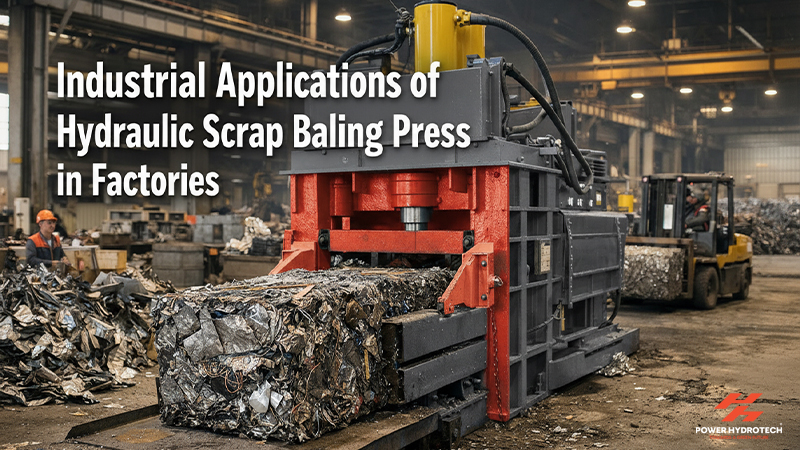
A Hydraulic Scrap Baling Press is a machine used in industry which presses the scrap into hard bales under the influence of hydraulic pressure. The scrap is introduced into a chamber, and a hydraulic ram forces the material into the chamber in controlled intervals. Once the material has been pressed, it is strapped together and ejected out of the press. The outcome is a small bale which is easy to stack, store, transport and handle. Hydraulic systems are used in industrial balers since they have constant, predictable force. This brings about uniform bale density and reliable daily operation. To put it in simple terms, a hydraulic scrap baler transforms disorganized, sloppy scrap into orderly blocks, which can be stacked in a corner into order.
Types of Scrap Commonly Baled in Factories
Factories generate different kinds of scrap depending on the industry. The good thing is, many scrap types are compressible, which makes them suitable for baling. This includes paper scrap, cardboard waste, packaging film, plastic waste, textile scraps, PET bottles, and similar materials.
Some factories also handle heavier scrap categories in separate systems. But in most general industrial setups, the biggest scrap challenge is bulky waste. That is where a Hydraulic Scrap Baling Press delivers maximum benefit.
This is also why factories prefer a baling press over random waste storage methods. A baler is not limited to one waste stream. It supports multiple scrap types, which makes it a long-term solution rather than a short-term fix.
Industrial Applications of Hydraulic Scrap Baling Press in Factories
Scrap baling is not only for recycling yards. It is heavily used inside factories as part of daily waste handling. Below are the most common industrial applications where a Hydraulic Scrap Baling Press plays a critical role.
1) Manufacturing Plants with Packaging Waste
Walk into any manufacturing plant and you’ll see it. Cartons. Boxes. Paper wraps. Plastic packaging. It comes in with raw materials, every single day. And the waste? It piles up fast. If you don’t bale it, it starts eating your storage space. It creeps near receiving docks. It becomes clutter. Annoying clutter.
A Hydraulic Scrap Baling Press solves that in a very practical way. It compresses loose packaging into tight bales, so you can stack them properly and dispatch them on schedule.
This is super common in:
- FMCG units
- Consumer goods manufacturing
- Electronics plants
- Pharmaceutical production facilities
2) Warehouses and Distribution Centres
Warehouses are basically cardboard factories in disguise. Every shipment creates waste — cartons, fillers, stretch film, wrapping sheets. Loose waste doesn’t just look bad. It blocks movement. It slows operations. At a certain scale, storing waste loosely becomes impossible. Period.
That’s why warehouses adopt baling early. It keeps the facility clean, reduces space usage, and makes waste handling predictable.
A Hydraulic Scrap Baling Press helps warehouses:
- Save storage space.
- Improve housekeeping.
- Reduce scrap dispatch frequency.
- Keep waste from interfering with inventory movement.
This isn’t just waste management. It’s warehouse discipline.
3) Printing, Publishing, and Paper Processing Units
Printing units generate paper scrap every day. Trimming waste, rejected sheets, cuttings, leftover rolls — it never stops. And paper scrap is sneaky. If you store it loosely, it spreads everywhere. It gets messy fast. It becomes a handling headache. Baling changes the whole game. You get neat, uniform bales that are easier to store and easier to sell to recyclers. This is one of the strongest industrial use cases for scrap balers. Especially for paper-heavy industries.
4) Textile and Garment Factories
Textile waste looks harmless at first. It’s lightweight. Soft. But don’t underestimate it. Cotton waste, fabric trims, cutting scraps — they take up insane space. Loose textile waste spreads quickly and turns into a daily housekeeping problem. A Hydraulic Scrap Baling Press compresses that bulky waste into compact bales, making storage cleaner and safer.
Even though textile waste isn’t heavy, it’s one of the most space-consuming scrap categories. Baling helps regain space fast. Really fast.
5) Food and Beverage Facilities with Secondary Packaging Waste
Food and beverage facilities generate packaging waste from cartons, wrappers, outer packaging, and dispatch materials. Hygiene standards are strict in such environments, and waste must be managed carefully. A baling press helps keep the waste area clean and structured, supporting better housekeeping and easier waste segregation. This is especially valuable for facilities that handle large dispatch volumes and require consistent waste storage methods.
6) Recycling Units and Scrap Aggregation Centres
Scrap aggregation centres collect waste from multiple sources. Their challenge is volume control and dispatch efficiency. Baling is essential here because loose scrap becomes impossible to store at scale. A Hydraulic Scrap Baling Press helps create dense bales that are easy to stack, transport, and sell. This application is one of the most direct and common uses of baling presses in industrial waste ecosystems.
How a Hydraulic Scrap Baling Press Improves Waste Handling
The biggest improvement is not only compaction. It is control. Once scrap becomes bales, waste handling becomes structured. Loose scrap creates daily unpredictability. One day the waste corner is manageable. Next day it overflows. Workers keep shifting scrap. Supervisors keep arranging pickups. Transport keeps happening more often than needed. This cycle drains time and money.
A Hydraulic Scrap Baling Press breaks that cycle by converting scrap into a standardized output. It gives factories a repeatable process: collect scrap, load scrap, compress scrap, tie bale, store bale, dispatch bale. This workflow is stable. It scales with volume. And it makes waste handling a planned activity instead of daily firefighting.
Space Saving: The Most Visible Benefit
Space is one of the most expensive assets in factories. Loose scrap steals that asset. Cardboard, paper, and packaging waste can occupy large areas quickly. This reduces operational efficiency because workers and forklifts need clear pathways to move.
Baled scrap takes far less space. Bales stack properly. Storage becomes organized. Walkways stay clear. Waste areas look professional. This is often the first benefit factories notice after installing a baler.
A factory that installs a Hydraulic Scrap Baling Press often sees immediate space recovery, especially in high-volume packaging environments.
Better Housekeeping and Cleaner Facility Management
Factories that handle scrap loosely often struggle with housekeeping. Loose paper and packaging waste spreads into corners. Plastic wraps blow around. Waste zones become untidy. Over time, this affects the entire facility’s cleanliness.
Baled scrap stays contained. It does not spread easily. It reduces daily cleanup pressure. It also improves the facility’s appearance during client visits, internal audits, and safety inspections. This is about looks. A cleaner facility supports better productivity and reduces operational stress.
Transport Efficiency and Lower Dispatch Frequency
Loose scrap fills trucks quickly, which leads to frequent dispatch cycles. More trips mean more fuel cost, more loading time, and more labour involvement. This becomes a long-term expense. Bales are dense and stable. They stack properly in vehicles. A Hydraulic Scrap Baling Press helps factories transport more scrap per trip, reducing dispatch frequency and improving logistics planning.
This advantage is especially valuable for factories that dispatch scrap weekly or multiple times a week. Over time, the savings in transport and labour become noticeable.
Better Recycling Handling and Improved Scrap Value
Recycling partners prefer baled scrap because it is easier to store, handle, and process. Loose scrap is inconsistent and can be contaminated easily. Bales provide a standardized form that improves handling speed.
This does not mean unrealistic claims like “huge profit.” But it does mean smoother recycling operations and better dispatch reliability. A Hydraulic Scrap Baling Press supports a cleaner and more professional scrap supply chain.
Safety Improvement and Compliance Readiness
Loose scrap creates hazards. It blocks pathways. It creates trip risks. It can block fire exits. It makes the facility look unmanaged. Safety audits become stressful when waste zones are messy. Baled scrap is safer. It stays contained. It stacks properly. It reduces clutter. A Hydraulic Scrap Baling Press supports better waste storage discipline and improves compliance readiness for factories that face internal audits, safety checks, or sustainability reporting.
What to Look for When Buying a Hydraulic Scrap Baling Press
A baler is a long-term machine. Choosing the right one matters. Factories should focus on practical performance rather than only looking at basic specifications. A good Hydraulic Scrap Baling Press should have a strong structural frame that handles repetitive pressing cycles without deformation. The hydraulic system should be stable and designed for consistent performance. The machine should produce uniform bales that hold shape and stack properly. Operator safety should be supported through practical design. Maintenance access should be simple, because downtime creates scrap overflow quickly. Service support is also critical. Scrap does not stop. Waste continues daily. That’s why choosing a reliable manufacturer matter.
Why Choose Us
Choosing the right scrap baler supplier isn’t just about buying a machine. Honestly, it’s about choosing a system your factory will depend on every single day. For years. Because scrap doesn’t stop. It shows up daily. And if your baler can’t keep up, everything gets messy fast — storage fills up, dispatch becomes chaotic, and the whole place starts looking unorganized. That’s where Power Hydrotech Private Limited stands out.
We focus on building durable, performance-driven baling solutions made for real industrial conditions — where scrap generation is continuous and the machine has to run without excuses. With a strong build, stable hydraulic performance, and consistent bale output, our balers help factories keep scrap handling clean, safe, and properly controlled.
When you choose Power Hydrotech Private Limited, you’re not just choosing a baler.
You’re choosing long-term reliability, practical engineering, and a waste-handling solution that improves operations — without adding extra burden on your team.
Conclusion
Industrial scrap handling becomes costly when scrap is left loose, bulky, and unmanaged. It starts taking over valuable floor space, creates mess around the work area, and adds extra labour every day without anyone noticing at first. A Hydraulic Scrap Baling Press makes this entire process simpler by compressing scrap into compact, uniform bales that are easier to store, safer for workers to handle, and much more efficient to transport.
It helps reduce space usage, improves housekeeping, cuts down wasted labour time, and makes recycling dispatch smoother and more planned. For factories that generate scrap daily, a baling press isn’t just a machine — it’s a long-term solution that brings control and discipline to waste management. Power Hydrotech Private Limited offers reliable baling machines built for real industrial performance, helping businesses manage scrap in a cleaner, more organized, and more efficient way.
For more information about Hydraulic Scrap Baling Press solutions for your factory, call +91 9726044442 or email sales@powerhydrotech.com and connect with Power Hydrotech Private Limited.
Key Takeaways
- A Hydraulic Scrap Baling Press converts loose industrial scrap into compact bales for easier storage and dispatch.
- Baling reduces space usage and keeps factory waste zones cleaner.
- Dense bales improve transport efficiency and reduce dispatch frequency.
- Baled scrap supports safer facility movement and better housekeeping discipline.
- Power Hydrotech Private Limited provides baling solutions built for daily industrial waste handling.
FAQs
What is a Hydraulic Scrap Baling Press used for?
It is used to compress loose scrap like paper, cardboard, plastic, textile waste, and packaging materials into compact bales for easier storage and transport.
Which factories need a hydraulic scrap baling press?
Factories with daily scrap generation such as manufacturing plants, warehouses, printing units, textile factories, and packaging facilities benefit the most.
Does scrap baling reduce waste handling labour?
Yes, because waste becomes easier to store and move, reducing repetitive shifting and manual packing inside the factory.
Is baled scrap better for recycling partners?
Yes, recycling buyers prefer bales because they are uniform, easier to stack, and faster to load and unload during dispatch.
Why choose Power Hydrotech Private Limited for scrap baling machines?
Because Power Hydrotech Private Limited focuses on durable construction, stable hydraulic performance, and practical support for long-term industrial use.