Industrial waste is rarely the “main problem” in a factory. That’s what makes it dangerous. It sits quietly in the background while production runs, orders move, and teams stay busy. But slowly, waste starts controlling the workplace. It takes space. It increases movement time. It clutters loading areas. It creates safety risks. And one day, you realize something uncomfortable: your waste handling process is costing you more than the waste itself. This is exactly where a Hydraulic Baling Press becomes one of the most practical machines for modern industrial waste management. It doesn’t just compress waste. It organizes your entire waste flow. It gives you control. It creates a predictable output. And it helps industries handle cardboard, plastic, textile scraps, PET bottles, paper, and other compressible waste in a cleaner and more efficient way.
The Real Industrial Waste Problem: It’s Not Waste, It’s Volume
Most of the industrial wastes are not heavy. It’s bulky. That’s the issue. Even at a low weight, cardboard packages, stretch film, plastic packaging, textile scraps, cotton waste, paper, PET bottles, and soft plastics take massive space. The loose waste when remained in a loose state is spread in corners, obstructs walkways, occupies storage areas, and subjects cleaning to continuous pressure. The employees continue to move garbage around. The pickups are continued to be set by supervisors. There is too much arrival of trucks. And the factory is steadily losing useful space daily.
This is why industrial waste handling becomes a recurring operational cost. It affects productivity because workers waste time moving waste. It affects safety because waste piles create hazards. It affects compliance because audits and inspections become difficult. And it affects logistics because loose waste makes transport inefficient. A Hydraulic Baling Press solves this specific problem: volume. It compresses bulky waste into dense bales that are easy to store, stack, and transport.
What Is a Hydraulic Baling Press?
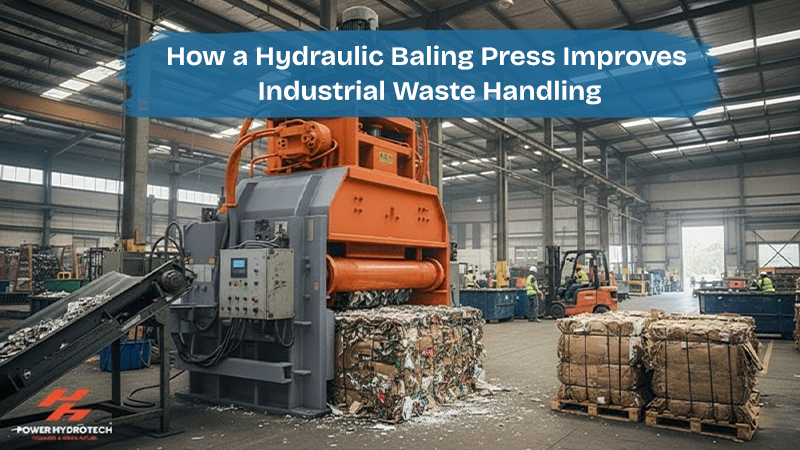
A hydraulic baling press is an industrial machine that compresses loose waste materials into compact bales. Tied bales using hydraulic force. The machine has a chamber where waste is loaded, and a hydraulic ram that applies controlled pressure to compress the material. Once the waste reaches the required density, it is tied using strapping and ejected as a finished bale.
The output is simple but powerful: uniform bales. These bales are easier to store, safer to handle, and simpler to transport. In industrial environments, this matters because waste is generated continuously. Without a structured system, waste handling becomes reactive. With a baling press, waste handling becomes planned.
Why Hydraulic Baling Technology Fits Industrial Waste Handling So Well
Industrial waste handling needs three things: consistency, speed, and control. Manual waste compaction is inconsistent and labour heavy. Open storage creates mess and safety issues. Random pickups increase transport cost. Hydraulic baling technology offers a structured process that fits daily industrial routines.
A Hydraulic Baling Press gives a factory a fixed waste output format. Instead of dealing with loose piles of waste, the facility produces bales that can be stacked in a defined area. This improves housekeeping, reduces clutter, and supports smoother internal logistics. The machine becomes a waste management backbone. Quiet. Reliable. Daily-use friendly.
Key Waste Streams That Can Be Managed with a Hydraulic Baling Press
Industrial facilities don’t just produce one kind of waste. They produce a whole mix. Every single day. And most of it is compressible, which is exactly where a baling press becomes a smart, long-term investment — not some one-time, single-use machine.
A Hydraulic Baling Press is commonly used for materials like:
- Cardboard waste
- Paper waste
- PET bottles
- Soft plastics
- Packaging film
- Textile scraps
- Cotton waste
- And other similar compressible materials
That’s the real advantage. It’s flexible. One machine can handle multiple waste streams without needing separate setups or extra equipment. So whether you’re running a warehouse, a factory, a logistics hub, a recycling yard, or a large commercial facility — it fits right in. And honestly, the bigger the facility, the more valuable this flexibility becomes. Because waste is never just one type. It’s always mixed. Always. Across departments, shifts, and daily operations.
How a Hydraulic Baling Press Improves Waste Handling: The Real Operational Impact
Baling doesn’t just reduce waste size. It changes how waste moves through the facility. That’s the real improvement. Once a factory installs a Hydraulic Baling Press, waste stops spreading. Waste stops blocking. Waste stops demanding daily firefighting. The factory starts handling waste in a controlled workflow: collect, load, compress, tie, store, dispatch. This workflow is predictable. It is repeatable. And it scales when waste volume increases.
Many businesses underestimate the mental and operational relief that comes from structured waste handling. Because when waste stays under control, everything else runs smoother.
Major Space Saving in Industrial Premises
Space is expensive in any factory. No doubt. And when waste starts piling up, it doesn’t just look messy — it literally steals working space. Loose cardboard and plastic packaging can take over an area fast, forcing you to waste valuable floor space just to store trash. A Hydraulic Baling Press fixes that by compressing waste into tight, dense bales. The volume drops big time. Now you can stack the bales neatly, store them in a smaller corner, and keep the plant looking clean.
Walkways stay open. Storage feels organized. Loading zones look better. Workflows move smoother. And honestly, this is usually the first benefit factories notice. It’s instant. It’s visible. And it makes daily operations easier.
Faster Housekeeping and Reduced Labor Waste
Industrial waste handling often becomes a hidden labour cost. Workers break boxes, flatten waste manually, shift piles, and keep cleaning the same zones repeatedly. This is time that could be spent on productive tasks.
With a Hydraulic Baling Press, waste handling becomes simpler and faster. Workers load waste into the machine, compress it, and store the bale. The repeated shifting and manual compacting reduce. The housekeeping team gets relief. The facility stays cleaner without constant effort. This matters in high-volume environments like warehouses, packaging units, and manufacturing plants where waste is continuous.
Reduced Transport Cost and Better Truck Utilization
Loose waste creates transport inefficiency. Trucks fill quickly with light material, forcing more trips and higher fuel usage. This becomes a long-term cost burden, especially for businesses that dispatch waste frequently.
Baled waste changes transport economics. A bale is dense and stable. It stacks properly in vehicles. It reduces empty space inside trucks. A Hydraulic Baling Press helps factories dispatch more material per trip, reducing pickup frequency and improving dispatch planning. This is one of the most practical cost benefits of baling. It does not require complicated calculations. The operational difference is obvious in real life.
Better Recycling Handling and Cleaner Waste Output
Recycling partners almost always prefer baled material. It stores better. It loads faster. It’s simply easier to handle. Loose waste, on the other hand, is messy, inconsistent, and it can get contaminated quickly — which slows everything down and weakens the recycling process.
That’s exactly why we recommend a Hydraulic Baling Press for any factory or facility that wants waste handling to feel controlled and professional, because once the material is compressed into uniform bales, it stays stable during storage and transport, it looks cleaner, and it supports better segregation across the entire recycling chain. We noticed that when waste is baled properly, the waste zones inside factories stay far more organized, and that directly supports sustainability goals, audit readiness, and compliance reporting.
We remember how common it used to be for waste areas to turn chaotic, honestly, just because the material was loose and hard to manage. And we realized this isn’t really about chasing unrealistic profits — well… it’s about making waste handling smoother, safer, and reliable every single day. Clean waste zones matter.
Improved Safety and Compliance Readiness
Waste piles create hazards. They block fire exits. They narrow aisles. They increase trip risks. They make the facility look unmanaged. And in industrial environments, safety is not optional. It’s daily.
Baled waste is safer because it stays contained. It stacks properly. It reduces clutter. A Hydraulic Baling Press supports safer housekeeping and helps factories maintain cleaner, more compliant waste storage zones. During audits and inspections, a structured baling system reflects a better waste management culture. This is a quiet advantage, but it is one of the most valuable one’s long terms.
How a Hydraulic Baling Press Works in Daily Industrial Operations
The process is designed for simplicity. Waste is collected from production zones or packing stations. It is loaded into the baler chamber. The hydraulic ram compresses it in stages. Once the bale reaches the desired density, it is tied with strapping. The bale is then ejected and moved to storage.
This workflow creates a consistent waste output. It removes randomness from waste handling. And it makes dispatch planning easier because bales are predictable in size and storage method. In real facilities, this is the difference between constant waste chaos and controlled waste management.
Why Choose Us
Choosing a baling machine supplier isn’t just a purchase. It’s a waste management decision that quietly shapes daily operations for years. At Power Hydrotech Private Limited, we focus on building baling presses that are made for real industrial conditions — where waste handling is continuous, loads are heavy, and performance has to stay stable day after day. We noticed that many machines look good on paper, but in actual factory use, weak frames, unstable hydraulics, and inconsistent bale output create daily frustration and unnecessary downtime.
That’s why our approach stays practical. Strong structural build. Reliable hydraulic design. Safe operation. And most importantly, consistent bale formation that keeps waste handling cleaner, safer, and more structured across the facility. We realized something over the years: when waste handling becomes disciplined, everything else inside the plant runs smoother too.
When you choose Power Hydrotech Private Limited, you’re choosing a baling solution built for long-term efficiency, not short-term promises.
Conclusion
Industrial waste handling becomes expensive when waste stays loose, bulky, and unmanaged. A Hydraulic Baling Press fixes that by compressing waste into compact bales that are easier to store, safer to handle, and far more efficient to transport. It reduces floor space usage, lowers labour effort, improves housekeeping, and makes recycling dispatch smoother and more predictable.
For factories, warehouses, and industrial facilities generating daily waste, a baling press is not an extra machine — it’s a long-term operational tool. And honestly, once waste starts moving in uniform bales, the entire waste zone feels more controlled and professional.
At Power Hydrotech Private Limited, we manufacture durable and reliable baling machines designed for industrial performance. With stable hydraulics, strong build quality, and consistent bale output, we help businesses handle waste with better control, cleaner operations, and long-term confidence.
For more information on Hydraulic Baling Press solutions, call +91 9726044442 or email sales@powerhydrotech.com to connect with Power Hydrotech Private Limited.
Key Takeaways
- A Hydraulic Baling Press reduces waste volume and frees up major industrial space.
- Baling improves housekeeping and cuts down daily waste clutter.
- Dense bales lower transport costs by reducing frequent trips.
- Baled waste is easier for recyclers to handle, stack, and store.
- Power Hydrotech Private Limited provides baling machines built for long-term industrial use.
FAQs
What is a Hydraulic Baling Press used for?
A Hydraulic Baling Press is used to compress loose industrial waste like cardboard, plastic, textile scraps, and paper into compact bales, making storage, handling, and transport much easier.
Which industries benefit most from a hydraulic baling press?
Factories, warehouses, logistics hubs, recycling yards, packaging units, and large commercial facilities benefit the most because baling brings structure and discipline to daily waste handling.
Does baling waste reduce transport cost?
Yes. Baled waste takes up far less space, so trucks can carry more material per trip, reducing dispatch frequency, loading time, and overall transport effort.
Is a hydraulic baling press suitable for daily industrial use?
Yes. Hydraulic balers are built for repetitive compression cycles and consistent bale output, which makes them suitable for daily industrial waste management.
Why choose Power Hydrotech Private Limited for baler machines?
Because Power Hydrotech Private Limited focuses on durable build quality, stable hydraulic performance, and practical support for industrial waste handling.